On this page
No hype, no theatre — just the mechanism laid out step by step, what the vendor says is running behind the button, and an honest picture of what your first seven days will really look like.
Read this first: the button below does not take you to a checkout. It opens the free official video presentation, where the whole system is explained from start to finish. Watch it all the way through, think it over with a clear head, and decide afterwards — there is no rush and no obligation.
Every make-money product you have ever bought sold you instructions. This one claims to sell you infrastructure. That distinction is the entire product, and understanding it is the difference between evaluating this offer properly and arguing about the wrong thing.
Instructions transfer the work to you. Infrastructure keeps the work on the seller's side. A course says "here is how to build a campaign" and then leaves you alone with fifteen unfamiliar tasks. The Push Button System says "the campaign is built, here is the switch" — and if that claim holds, it removes every one of the fifteen places a beginner normally gets stuck.
Which is exactly why the whole thing hinges on one question: is the infrastructure real, and does it perform? Not "does the button work" — buttons always work. Does what sits behind it actually produce sales.
This is a step, not a formality. The pricing structure, the deferred $10,000 term and the three admitted weaknesses are all disclosed inside the video — several of them late. Skipping to the order button means buying without the disclosures.
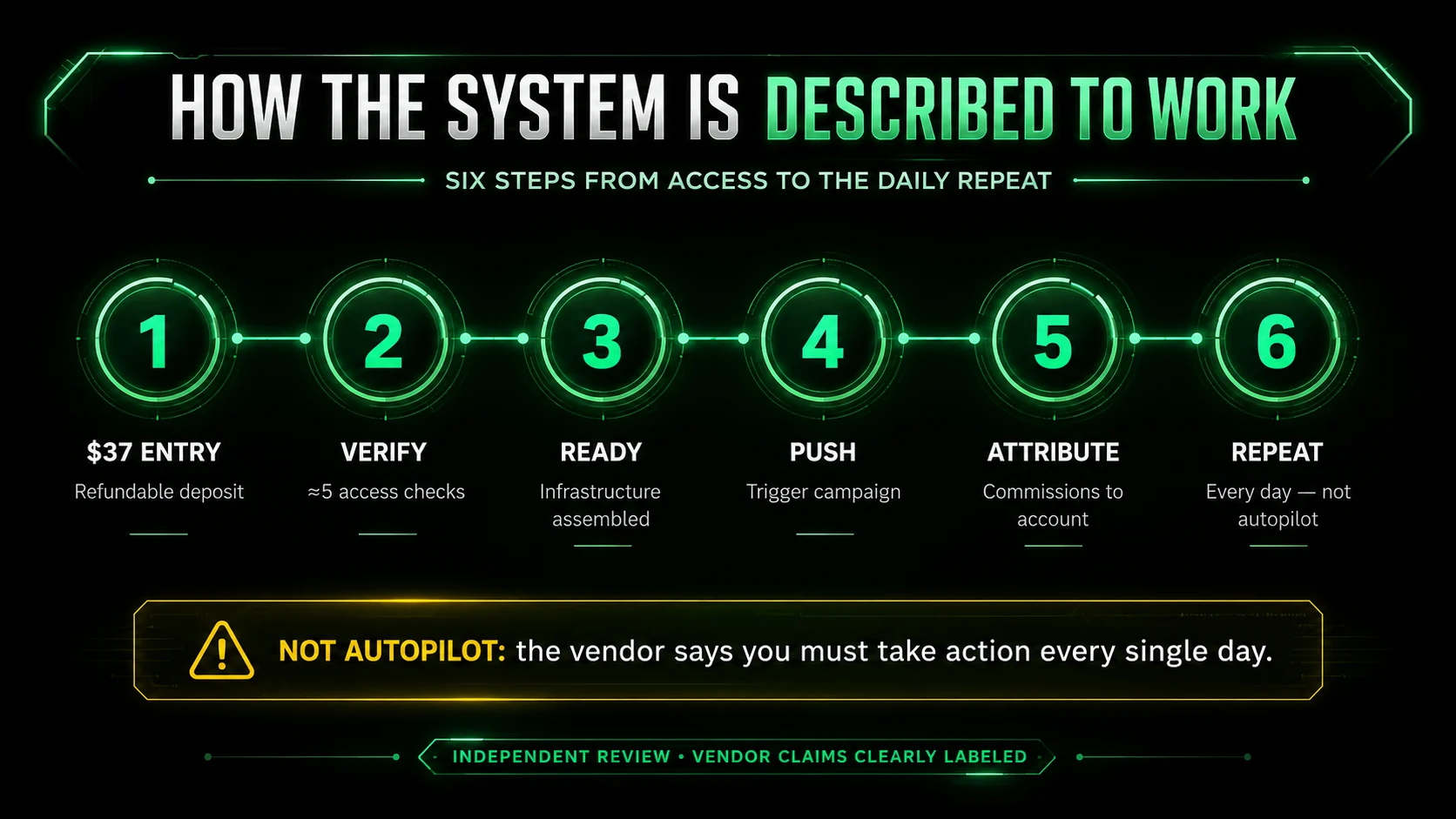
Framed as a filter rather than a price. This is the point to read the checkout terms carefully — the refund wording, any recurring charge, and anything referencing the deferred obligation.
Identity and access checks between you and the dashboard. The vendor says the button sits behind several firewalls, and that he disabled them personally for the filmed demonstrations — meaning what you experience will be slower than what the video shows. Budget minutes, not seconds.
One click launches the campaign. No niche to choose, no offer to pick, no page to write, no traffic source to configure. The vendor's electricity analogy: you flip a switch and current flows through wiring installed long before you arrived.
Sales from that campaign credit to you. You never touch fulfilment, customer support, refunds or payment processing — those stay entirely on the vendor's side of the operation.
The step people ignore and then blame the product for. The vendor is explicit: this is not autopilot. He describes pushing it morning and evening. A day without a push is a day without a campaign, and a day without a campaign earns exactly nothing.
Heads up: clicking below opens the official free presentation — a video that walks you through the entire system before any decision is asked of you. Watch it in full, sleep on it if you want, and decide calmly.
The presentation describes six components pre-assembled on the vendor's side. Here is each one and, more usefully, why it matters — because each corresponds to a specific reason beginners normally fail.
| Component | The failure it removes |
|---|---|
| Pre-selected offers | Beginners pick bad offers — low converting, low paying, or already burnt out. Choice removed means that failure removed. |
| Pre-generated affiliate links | Network applications get rejected without traffic history. Pre-attribution sidesteps the approval wall entirely. |
| Pre-written landing pages | Copywriting is a craft, not a weekend. Most beginner pages convert near zero regardless of traffic quality. |
| ≈40 connected traffic sources | The number one killer. Most beginners never get meaningful traffic at all, so nothing downstream ever gets tested. |
| Fulfilment & payment handling | Support tickets, chargebacks and refund handling sink solo operators. None of it reaches you. |
| The one-click interface | Decision paralysis. Fifteen choices become one action, and an action you can actually complete beats a plan you cannot. |
Every row above describes a real reason real beginners fail, and removing it would genuinely help. That is why this offer is more interesting than the usual course. But "the traffic is pre-connected" is a claim about volume and quality that no outsider can measure — and volume and quality are the only things that determine whether any of it pays. The architecture is credible. The output is unproven.
Heads up: clicking below opens the official free presentation — a video that walks you through the entire system before any decision is asked of you. Watch it in full, sleep on it if you want, and decide calmly.
Forget the park footage. Here is a grounded picture of the first seven days, built from how offers like this normally behave rather than from how this one is advertised.
Not fraud. Not the product. Drift. They buy, get distracted, push the button twice, never look again, and surface four months later having forgotten the refund window entirely. Set the calendar reminder on day one. It takes fifteen seconds and it is the single highest-value action in this entire process.
The purchase itself is minutes. The roughly five verification steps add more — the vendor notes he disabled them for the filmed demos, so your experience will be slower than what the video shows. Budget an hour to do it properly and read everything.
Yes, and this comes from the vendor himself. He states directly that it is not an autopilot system, and describes his own routine as pushing it morning and evening. A skipped day is a day with no campaign.
Nothing in the presentation restricts it geographically. Confirm your country and payout method are supported on the checkout page before purchasing, since payment processors do vary by region.
According to the vendor, no — around forty traffic sources are described as pre-connected, and that is the central claim of the entire product. It is also the claim that cannot be verified from outside.
The presentation does not specify limits. The creator describes pushing twice daily as his own routine. Assume normal usage rather than unlimited stacking until the dashboard tells you otherwise.
Everything on this page is a summary of claims made by the vendor. The only way to judge them properly is to watch the official presentation yourself, from beginning to end, and form your own view — unhurried, with nothing charged and nothing committed.
One last thing: the button opens the official free presentation. No payment, no commitment to watch. It explains the system end to end so you can make an informed, unhurried decision instead of a rushed one.
The Push Button System works by relocating the entire affiliate campaign build from the buyer to the vendor. Where conventional affiliate marketing requires a beginner to select offers, obtain network approval, register a domain, host and build a landing page, write conversion copy, install tracking and then master a traffic source, this system claims all of it is pre-assembled — leaving one action: pushing a single button to trigger a live campaign.
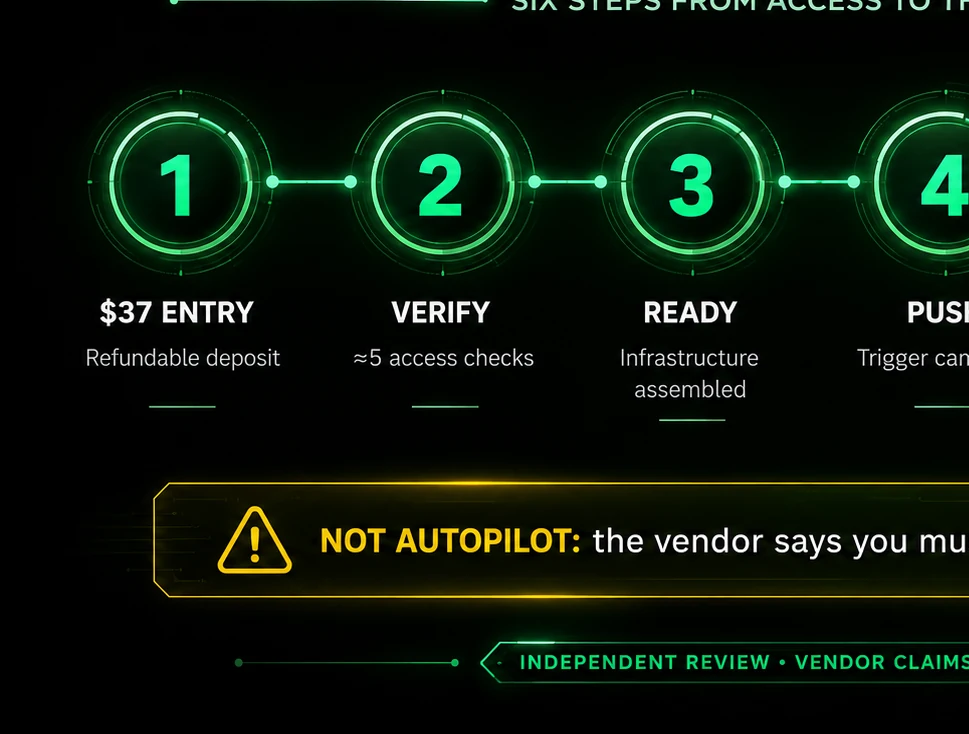
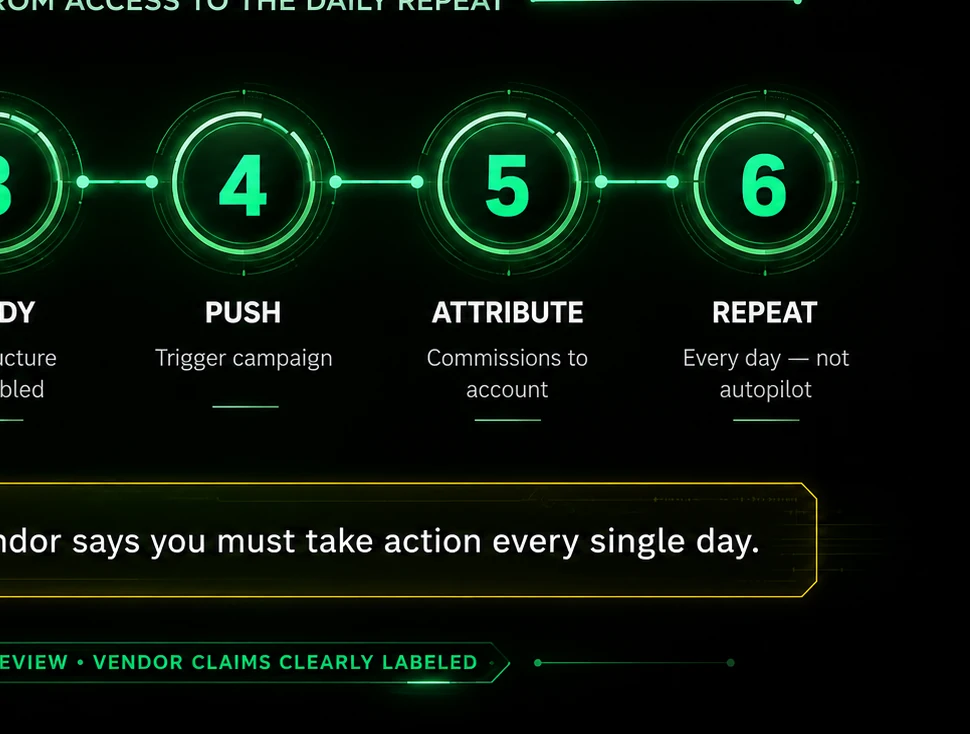
The stated process runs in six steps: watch the official presentation, place the $37 refundable deposit, complete approximately five verification steps, push the button once to launch, receive commission attribution on resulting sales, and repeat the push daily. The vendor states explicitly that the system is not autopilot and requires daily action — a limitation anyone searching how does the push button system work should factor in before purchasing.
Income disclaimer: every earnings figure referenced on this page is a claim made by the vendor in their own marketing material. It is unverified, not typical, not average and not a promise of your results. Most buyers of make-money-online products earn little or nothing. Nothing here is financial advice. Never spend money you cannot comfortably afford to lose.