On this page
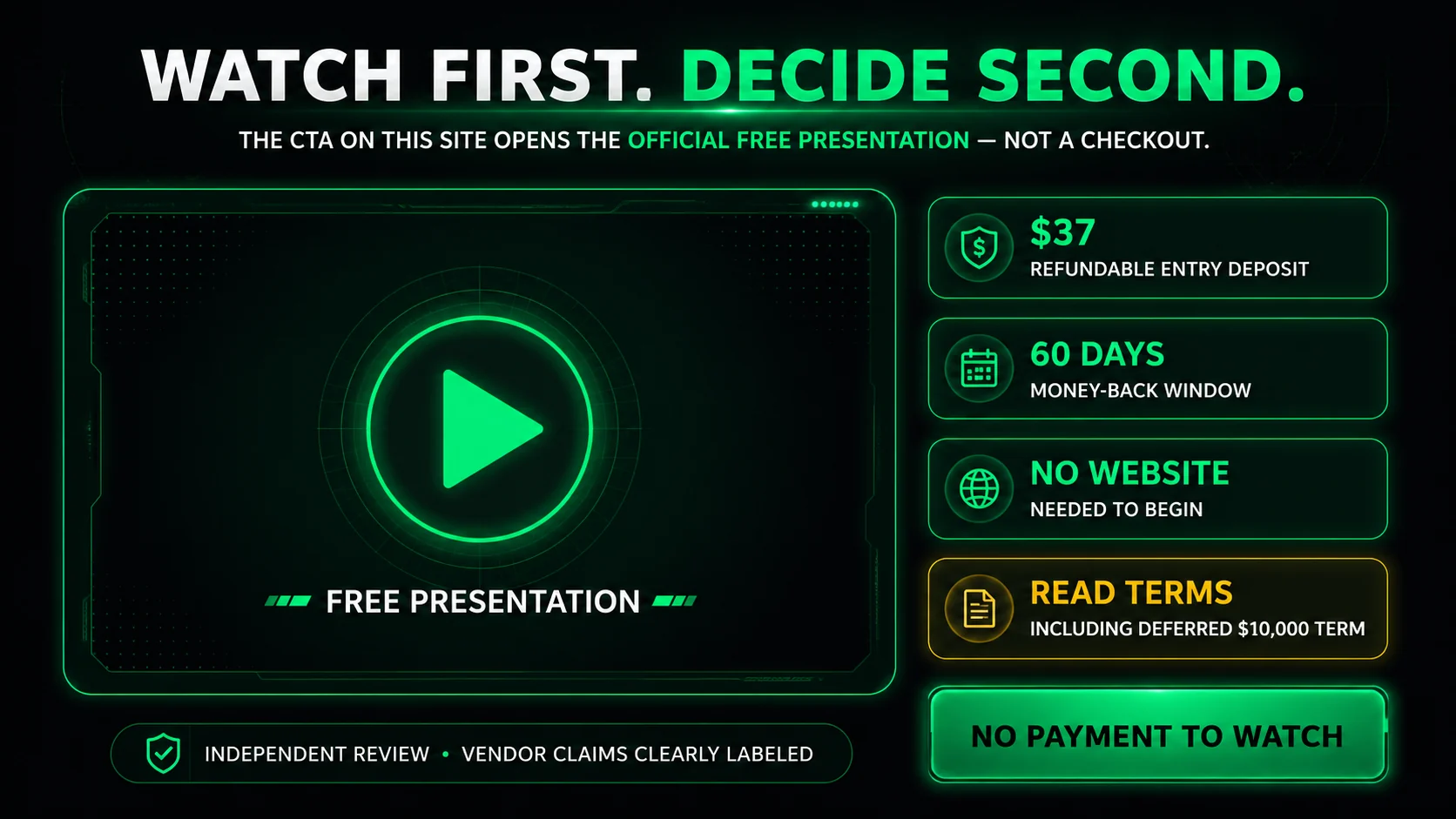
The headline is $37 and refundable. There is a second number disclosed three-quarters of the way through the presentation that most buyers never register. Here is the complete cost picture.
Read this first: the button below does not take you to a checkout. It opens the free official video presentation, where the whole system is explained from start to finish. Watch it all the way through, think it over with a clear head, and decide afterwards — there is no rush and no obligation.
The Push Button System is sold at $37, and the presentation is careful to call it a deposit rather than a price — money you can request back at any time, positioned as a filter that keeps non-serious people out rather than as revenue.
The framing is deliberate and it works. A price triggers a value judgement; a refundable deposit does not. If it comes back on request, the reasoning goes, it was never really spent. That is persuasive, and it is also largely true — which is precisely why this offer's downside genuinely is small.
Prices, currencies and terms are set by the vendor and change without notice. Before you pay, read the actual checkout page for the current price, any recurring billing, the exact refund wording and the refund window length. Never rely on a third-party page — including this one — for a number you are about to be charged.
This is the most important paragraph on this page, and it concerns a number roughly 270 times larger than the one in the headline.
Roughly three-quarters of the way through the presentation, the creator states that the technology is worth $10,000, that you should pay $100,000 for it, and that you will in fact pay $10,000 — but only after you have made your first million dollars using it. He adds that this typically happens within three months and that he is therefore not worried about collecting, and that you will hear from him with a bill at that point.
Two readings, and both matter.
The benign reading: it is contingent. If you never earn a million dollars, you never owe anything, so it costs you nothing in any realistic scenario. Framed this way it is closer to a rhetorical device demonstrating confidence than a genuine liability.
The cautious reading: it is still a stated financial obligation attached to a product, disclosed deep inside a long video where attention is at its lowest, and framed as a favour rather than as a term. Placement like that is a choice. Whatever the intent, you should never accept a five-figure deferred obligation you have not read in writing.
What to actually do: before paying, read the checkout page and the terms and conditions in full, and look specifically for any language creating a future payment obligation. If it appears there, you know exactly what you are agreeing to. If it does not appear anywhere in writing, that is worth knowing too. Either way, you are deciding with information rather than assuming.
Heads up: clicking below opens the official free presentation — a video that walks you through the entire system before any decision is asked of you. Watch it in full, sleep on it if you want, and decide calmly.
The presentation quotes $37. Your real exposure is whatever you allow it to become, and that is determined entirely by what happens after the purchase.
| Cost | Amount | Status |
|---|---|---|
| Front-end entry deposit | $37 | Disclosed clearly in the presentation |
| Post-purchase upsells | Unknown — assume they exist | Not mentioned in the presentation |
| Deferred technology fee | $10,000 | Disclosed late in the video, contingent on your first million |
| Traffic or ad spend | $0 claimed | Traffic is described as pre-connected and included |
| Hosting, tools, software | $0 claimed | Infrastructure is described as vendor-side |
Because that is what a $37 front end is for. In this industry, low-ticket entry offers exist to acquire a buyer, and the economics almost never work on $37 alone. The profit sits in what follows: a "pro" tier, a faster-results tier, a coaching or done-with-you tier. This is not a scandal and it is not unique to this product — it is the standard architecture of the entire market.
Decide your absolute ceiling before you reach the checkout, and write it down. $37 and nothing more. Then decline everything above it — not because upsells are inherently bad, but because a decision made in thirty seconds on a page engineered to prevent deliberation is not a decision. If a tier genuinely appeals to you, it will still be available after you have slept on it.
Answer it as a cost-of-being-wrong question and it becomes easy.
Refundable. If it produces nothing, you request it back and lose an afternoon. That is the entire realistic downside at the front end.
Rarely fully refundable. You also inherit the workload the course describes — months of building before any test is even possible.
Non-refundable by definition, because you spent it on clicks. Most beginners lose their first test budget entirely while learning.
Judged as a cheap, capped, refundable test of a model you are curious about, $37 is defensible — possibly the cheapest look inside a done-for-you system you will find. Judged as an investment expected to return $20,000 per click, it is not defensible at any price, because that return has never been verified by anyone independent.
The price is not the risk here. Your expectations are the risk. Manage those and $37 is a rounding error. Fail to manage them and no price would have been low enough.
Heads up: clicking below opens the official free presentation — a video that walks you through the entire system before any decision is asked of you. Watch it in full, sleep on it if you want, and decide calmly.
$37 at the front end, described by the vendor as a fully refundable deposit. Verify the current figure and the exact refund terms on the checkout page before paying — prices change without notice.
The presentation describes it as a one-time refundable deposit. Check the checkout page carefully for any recurring billing language before you confirm payment. Never assume; read.
The video states the technology is worth $10,000 and that you will owe that amount after your first million dollars in earnings. It is contingent, so in most realistic scenarios it costs nothing — but it is a stated obligation and you should read the written terms before purchasing.
The presentation does not mention any, but you should assume they exist. That is the standard structure for every low-ticket front-end offer in this market. Set your ceiling at $37 in advance.
According to the vendor, no — traffic is described as pre-connected and included. That is the central claim of the product, and it is also the claim that cannot be verified from outside.
The vendor describes it as refundable at any time, administered by their payment processor under the terms shown at checkout. Keep your receipt and set a calendar reminder several days before the window closes.
Everything on this page is a summary of claims made by the vendor. The only way to judge them properly is to watch the official presentation yourself, from beginning to end, and form your own view — unhurried, with nothing charged and nothing committed.
One last thing: the button opens the official free presentation. No payment, no commitment to watch. It explains the system end to end so you can make an informed, unhurried decision instead of a rushed one.
The Push Button System price is quoted at $37, framed by the vendor as a refundable entry deposit rather than a purchase price, and described as a filter to limit access. The presentation states that no additional traffic spend, hosting, tools or software costs are required, since the campaign infrastructure sits on the vendor's side.
Two further costs matter to anyone researching how much the push button system costs. First, a deferred term of $10,000 is disclosed roughly three-quarters of the way through the video, payable only after a member's first million dollars in earnings — contingent, but a stated obligation that should be read in writing before purchase. Second, post-purchase upsells are not mentioned in the presentation but should be assumed, as they are the standard economic structure behind every low-ticket front-end offer in this market. Setting a hard $37 ceiling in advance is the single most effective protection.
Income disclaimer: every earnings figure referenced on this page is a claim made by the vendor in their own marketing material. It is unverified, not typical, not average and not a promise of your results. Most buyers of make-money-online products earn little or nothing. Nothing here is financial advice. Never spend money you cannot comfortably afford to lose.